
For decades, Republican leadership has insisted that “limited federal government” is the secret ingredient to American freedom. Less oversight, fewer rules, weaker institutions—because nothing says liberty like hoping powerful actors will restrain themselves out of kindness. According to this vision, once government steps aside, markets will behave, corporations will act ethically, and billionaires will suddenly develop a deep moral attachment to the public good. History, unfortunately, has refused to cooperate with this theory.
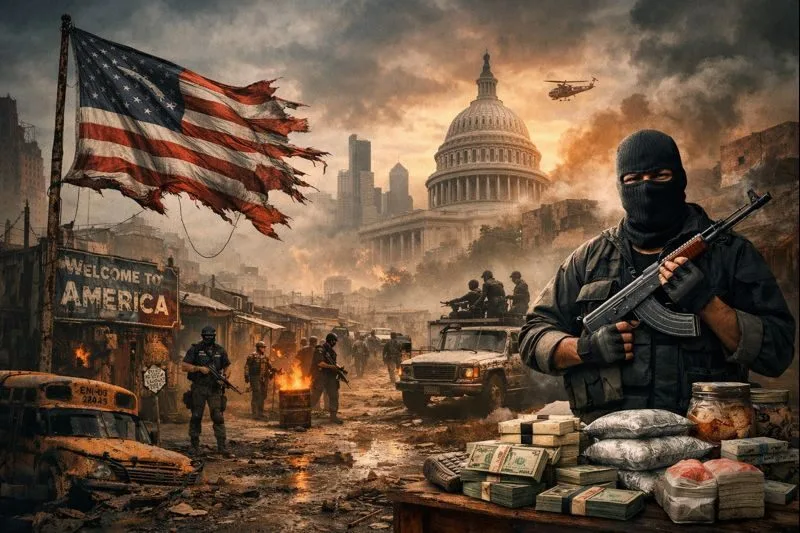
As federal authority retreats, Americans are discovering what “freedom” looks like when it is outsourced to corporations. Technology giants decide what speech is acceptable, private equity firms decide which hospitals stay open, and monopolies decide what groceries cost—often with more authority than elected officials. Courts are replaced by mandatory arbitration, worker protections by noncompete clauses, and public accountability by customer service chatbots. This is not deregulation; it is governance by corporate terms of service. The government didn’t disappear—it just rebranded as a subscription model.
Meanwhile, political leaders who champion “small government” have been remarkably enthusiastic about weakening elections, courts, and law enforcement—unless those institutions serve them personally. States are encouraged to ignore federal law when inconvenient, oversight agencies are gutted in the name of efficiency, and public trust is treated as collateral damage. The result is a nation where power is concentrated, accountability is optional, and the rule of law exists mostly as a nostalgic concept. This is not a third-world future caused by poverty; it is a premium, American-made version—where instability wears a suit, corruption files quarterly reports, and freedom is available to those who can afford it.
Welcome to Limited Government, U.S. Edition
- Corporations regulate speech faster than Congress can hold a hearing
- Arbitration clauses quietly replace courts and due process
- Private equity owns hospitals, housing, and nursing homes—temporarily
- Billionaires demand freedom from regulation while enjoying taxpayer-funded infrastructure
- States selectively enforce laws based on ideology
- “Small government” somehow requires massive police power—but only in certain neighborhoods
Conclusion
Power never disappears in a democracy—it just changes hands. When government steps back, someone steps forward, and it is rarely the average citizen. The GOP’s version of limited government doesn’t eliminate control; it privatizes it, concentrates it, and then calls the outcome freedom. If this is the plan, then the United States isn’t sliding toward a third-world future by accident—it’s sprinting there proudly, waving a deregulation banner, and insisting everything is fine.