
Donald Trump has never claimed to want a crown. He has simply described the presidency as if it came with one.
“I have an Article II, where I have the right to do whatever I want as president,” Trump said in 2019, during an interview meant to reassure the public that everything was under control. [AP] The sentence did not do that. It did, however, clarify a governing philosophy. Power exists. The document mentions me. Therefore the power is mine.
This is the backdrop for the modern Trump theory of executive authority. Loyalty is personal. Institutions are optional. Laws are flexible suggestions enforced by people who should probably be fired. When Trump later told supporters “I am your retribution,” he was not announcing a policy agenda so much as a mood. [Reuters] Government as grievance resolution service.
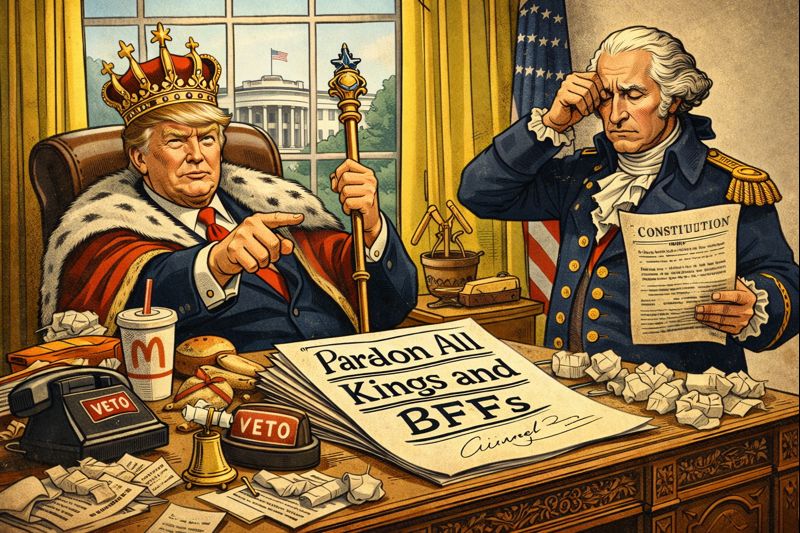
Now enter George Washington, a man who accidentally invented the presidency and then spent eight years trying not to turn it into a monarchy. Washington could have stayed in power. Many expected him to. Instead, he left. Twice elected. Twice declined a third term. Not out of humility theater, but because he believed concentrated power was corrosive, even when held by someone convinced of their own virtue.
What Would Washington Do, or WWWD, is not complicated here. He would read “Article II” and then read the rest of the Constitution. He would worry less about personal enemies and more about precedents. He would not describe himself as retribution. He would describe restraint as the job.
Washington warned against the “spirit of encroachment” and the slow normalization of authority that exceeds its bounds. He did this without cable news, rallies, or a merch store. He assumed the danger was structural, not partisan.
Trump’s defenders often argue that strongmen language is just talk. Washington understood that talk becomes habit, and habit becomes permission. Power does not need to announce itself as a king to behave like one.
Sometimes it just needs to be told it can do whatever it wants.
References
[AP] Associated Press, “Trump: ‘I have an Article II where I have the right to do whatever I want as president,’” April 2019.
https://apnews.com/article/5e9b3b1e3f5a4c4f8a2c1c4c2c0a0c9e
[Reuters] Reuters, “Trump tells supporters ‘I am your retribution’ at CPAC,” March 2023.
https://www.reuters.com/world/us/trump-says-he-is-supporters-retribution-cpac-2023-03-04/
[Mount Vernon] George Washington’s Farewell Address, 1796.
https://www.mountvernon.org/library/digitalhistory/digital-encyclopedia/article/farewell-address/